They told me it was a myth.
A high-altitude hallucination. A story told by monks to test the patience of outsiders. An orchid that blooms in snow, above the tree line, where lungs burn and thoughts thin.
“Nothing grows there,” they said. “Nothing soft survives.”
But I had seen a drawing once, pressed between the pages of a weather-stained field journal in a shop that smelled like cedar and dust. A pale bloom, cupped in frost. A name scrawled beneath it in ink that had nearly vanished: The Snow Orchid.
If it didn't exist, then the decision had already been made. I had to find it. So I went looking.
Years passed like wind across stone. I followed rumors up into the Himalayas, through villages carved into cliffsides, into monasteries thick with incense, where old men stirred butter tea and shook their heads at me.
I learned the patience of ice. I learned the sound of my own breath becoming harder to breathe. I learned a silence quieter than i thought imaginable.
The higher I climbed in Tibet, the quieter the world became. Even the sky felt close enough to touch.
Snow leopards moved through that silence like drifting fog. I never saw them clearly, only tracks, once a flash of tail disappearing behind a ridge. The mountain had guardians, that much was certain.
By the time I reached the highest pass I could manage, I was less a man and more a stubborn pulse inside a body that no longer agreed with me. My lips were split. My hands numb. I hadn't felt my feet or my legs in days, I just kept pushing higher and higher, deeper and further. I had one roll of film left in my camera. Thirty-six chances to prove I wasn’t mad.
On the day I found it, I was not heroic. I was exhausted. Angry. Ready to concede that the world was exactly as small as it pretended to be. Ready to admit that the one thing that I was told didn't exist, was in fact nonexistent.
I had stopped behind a boulder to escape the wind. It was the only mercy in the glittering landscape that offered none. The air on that side was strangely still. The snow lay softer, less carved by the storm. I leaned there, forehead against stone, and considered turning back.
That’s when I saw it.
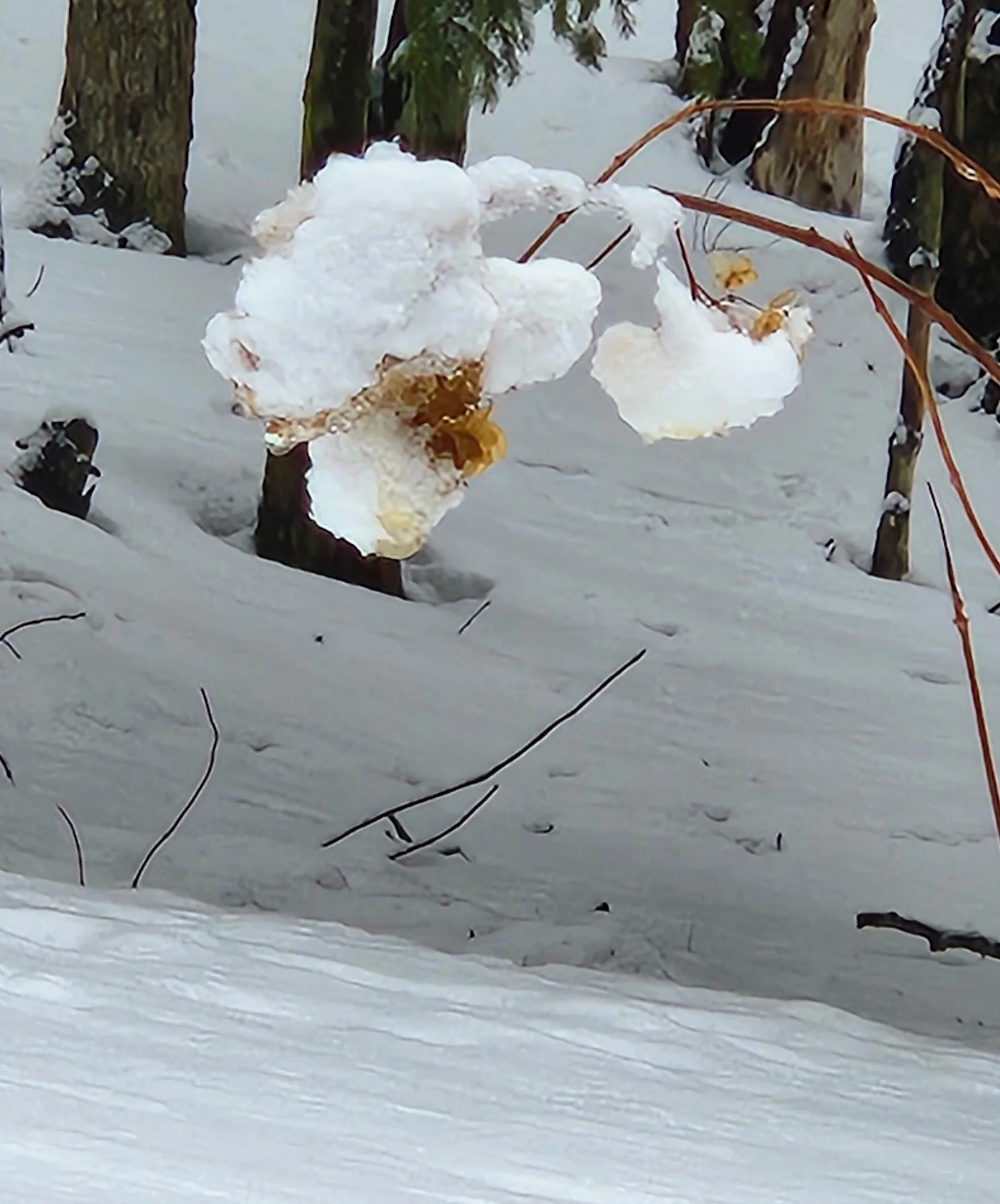
At first, it was just a suggestion in the drift. A curvature where snow should have been flat. I brushed at it with a shaking glove. Beneath the powder was something translucent. Not fragile in the way of petals, but resilient, almost crystalline. Pale gold at its core, as if the mountain had lit a candle inside it.
An orchid.
Its petals cradled snow without collapsing. Ice rimmed its edges like lace. It had found a pocket of balance behind the boulder—shielded from the worst of the wind, catching just enough light reflected from the glacier beyond. The exact recipe of survival in a place designed to erase softness.
I laughed then. A dry, cracking sound swallowed by altitude.
“You exist,” I told it. A tear escaped the corner of my eye, then froze to my cheek.
For a moment, just one moment, the wind stilled entirely. And on the ridge above, I felt the weight of being watched. I didn’t turn. I didn’t need to. The guardians had allowed this.
My fingers were clumsy as I lifted the camera. I adjusted the focus through a viewfinder fogged with my own failing breath. Click. The shutter sounded louder than it ever had in my life.
One frame left on the roll.
I took a second photograph, closer. Snow resting in the cup of the bloom like an offering.
Click. That was the last exposure.
I don’t remember lying down. I remember only the overwhelming quiet that followed. Not silence…quiet. The kind that feels intentional. As if the mountain had been waiting for me to stop struggling.
The cold was no longer sharp. It was distant. Gentle, almost.
The snow orchid remained upright behind its boulder, luminous in the dimming afternoon. The wind eventually returned, but it did not touch that small hollow of air. Above, somewhere unseen, a snow leopard shifted its weight and settled again.
They found me in the spring thaw.
A body half-kept by ice. A pack stiff with frost. And a camera, sealed in its case, tucked beneath my coat as if I had known to protect it more than myself.
The last frame on the roll was intact.
When the photograph was developed, people argued about it for years. Some said it was a trick of light. Some claimed the altitude had conjured a mirage. Botanists dismissed it outright, no orchid species could survive those temperatures, that wind, that soil.
But there it was.
A pale bloom rising from snow. Gold at its heart. Guarded by shadow.
They still say it doesn’t exist.
And maybe that’s the point.
Some things bloom only when someone is willing to lose everything for the proof.
The mountain keeps its secrets.
But sometimes, if you press your back against the right stone and let the wind move past you—
It lets you see one.